Showing posts with label cloud. Show all posts

Tuesday, December 6, 2016

Information Security Learning Resources part 2

   Today we have part 2 of a 2-part guest post by security analyst Chris Goff.  Chris has collected a set
of info, links and lists that definitely qualify as extremely cool resources!  You can check out Chris' website at http://chris-goff.com/ or follow him at https://www.linkedin.com/in/goffchris

   There's a lot of info packed in here, and it's pretty technical. But you don't have to memorize it all now and there won't be a test!  Just skim it, enjoy it and bookmark it!

Security Concepts
There are three key concepts of information security which you may or may not be familiar with:
    -      Confidentiality
o   Confidentiality is the characteristic of information whereby only those with sufficient privileges and a demonstrated need may access certain information. When unauthorized individuals or systems can view information, confidentiality is breached.
    -      Integrity
o   Integrity is the quality or state of being whole, complete, and uncorrupted. The integrity of information is threatened when it is exposed to corruption, damaged, destruction, or other disruption of its authentic state. Corruption can occur while information is being entered, stored, or transmitted.
    -      Availability
o   Availability is the characteristic of information that enables user access to information in a usable format without interference or obstruction. A user in this definition may be either a person or another computer system. Availability does not imply that the information is accessible to any user; rather, it means availability to authorized users.

This is known as the “security triad”. It can be further expanded upon:
    -      Privacy
o   Information that is collected, used, and stored by an organization is intended only for the purposes stated by the data owner at the time it was collected. Privacy as a characteristic of information does not signify freedom from observation (the meaning usually associated with the word), but in this context, privacy means that information will be used only in ways known to the person providing it. Many organizations collect, swap, and sell personal information as a commodity. It is now possible to collect and combine information on individuals from separate sources, which has yielded detailed databases whose data might be used in ways not agreed to, or even communicated to, the original data owner. Many people have become aware of these practices and are looking to the government for protection of the privacy of their data.
    -      Identification
o   An information system possesses the characteristic of identification when it is able to recognize individual users. Identification is the first step in gaining access to secured material, and it services as the foundation for subsequent authentication and authorization. Identification and authentication are essential to establishing the level of access or authorization that an individual is granted. Identification is typically performed by means of a user name or other ID.
    -      Authentication
o   An information system possesses the identity that he or she claims. Examples include the use of cryptographic certificates to establish Secure Sockets Layer (SSL) connections or the use of cryptographic hardware devices--for example, hardware tokens provided by companies such as RSA's SecurID--to confirm a user's identity.
    -      Authorization
o   After the identity of a user is authenticated, a process called authorization assures that the user (whether a person or a computer) has been specifically and explicitly authorized by the proper authority to access, update, or delete the contents of an information asset. An example of authorization is the activation and use of access control lists and authorization groups in a networking environment. Another example is a database authorization scheme to verify that the user of an application is authorized for specific functions such as reading, writing, creating, and deleting.
    -      Accountability
o   Accountability of information exists when a control provides assurance that every activity undertaken can be attributed to a named person or automated process. For example, audit logs that track user activity on an information system provide accountability. (Management of Information Security by Michael E. Whitman and Herbert J. Mattord)

Tuesday, November 22, 2016

Information Security Learning Resources part 1

   Today we have a guest post by security analyst Chris Goff.  Chris has collected a set of info, links and lists that definitely qualify as extremely cool resources!  You can check out Chris' website
at http://chris-goff.com/ or follow him at https://www.linkedin.com/in/goffchris

   There's a lot of info packed in here, and it's pretty technical. But you don't have to memorize it all now and there won't be a test!  Just skim it, enjoy it and bookmark it!


Information Security Learning Resources
or information security for the self-learner
by Chris Goff

This is the result of many years of notes. This is by no means an exhaustive list, nor the definitive path to information security.

If you come across a dead link, use the Internet Way Back Machine (https://www.archive.org).

Bookmark these Google Search cheat sheets, they will come in handy:

Official Google Cheat Sheet - http://www.google.com/help/cheatsheet.html

Google Advanced Operators Cheat Sheet - http://www.googleguide.com/print/adv_op_ref.pdf

Learning How To Learn - http://l.goodbits.io/l/407nqn1n

Core competencies

Here are three core competencies within information technology that will provide a solid foundation on which to start a security career:
  • Systems Administration
  • Network Administration
  • Programming
It is also critical that you learn to deal with people and business. Take some public speaking classes (Toastmasters: https://www.toastmasters.org/), volunteer for presentations at local groups, and volunteer to deliver training for folks at your workplace. One of the greatest methods of learning is to teach.

The core competencies are not a requirement, however be aware that InfoSec is expected to be a Subject Matter Expert (SME) on most topics. If you wish to be successful diversity of knowledge is key.
“There is no security without understanding.” – Michael Lucas, author Absolute OpenBSD

Tuesday, October 21, 2014

Dropbox Wasn't Hacked... This Time!

   I'm sure that many of you have read the news about an apparent attack, and subsequent account breach at Dropbox this past week.  There have been conflicting reports flying around, but Dropbox's own blog points out what appears to be the truth... Dropbox wasn't hacked.


   The story is that apparently the attackers got user IDs and passwords from attacks on other applications.  They then tried these same credentials on a number of internet sites, including Dropbox.  You can read the Dropbox blog post here.

  This is a typical attack scenario, as I've discussed before.  Among the value of stealing a password file from a site or organization is that people unfortunately reuse their IDs and passwords on other sites.  This is because it's difficult to remember all those passwords!  I won't go into that issue because I've covered it plenty of times in the past.

   In this case, like many others, the attackers simply try the IDs and passwords on other sites.  It's almost guaranteed that they will get some logins that work.  That is apparently what happened here.

   So... Dropbox wasn't hacked... this time!  Of course, there have been a number of successful breaches of Dropbox in the past!

   More on that in a moment, but I want to make a quick editorial comment on the use of the term "hacked".

Tuesday, July 16, 2013

Are You the Customer... or the Product?

   I regularly speak with people about Internet/Online Safety.  One message I frequently give about free online services is:
You're not the Customer... You're the Product.
   We often see people upset about changes in social networks like Facebook.  Folks complain about "customer service", not realizing that they are not the customer!  It's often the advertisers, or other backers, who are the real customers.  And what those customers want is information... about the users of the service.

   I'm a big fan of free online services, but it's important that people realize what's going on.  It starts with the privacy policy, which explains how an online service intends to use your data and information about you.

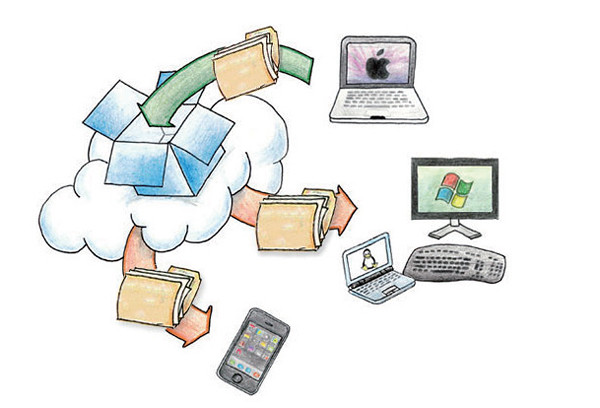
   But I want to talk about cloud storage services.  These services allow you to backup files, sync files between systems and devices, and have files available from anywhere.  How are your files protected?