Showing posts with label android. Show all posts

Tuesday, May 3, 2016

Secrets Your Phone Told Me

   You may remember that earlier this year we were all talking about the standoff between the FBI San Bernadino attack.  This specific problem was "solved" when the FBI said they were able to decrypt the phone and no longer needed Apple's help.  The assumption by many is that the FBI purchased an exploit used to break into the phone.
and Apple about the decryption of an iPhone used by one of the shooters in the

   This leads us to an important consideration and question... can any phone be hacked?  Is any information on your smartphone really private?

   We have become completely dependent upon our phones.  According to a 2015 Pew Research Center study, in the US over two-thirds of the population uses a smartphone.  We keep all of our personal information on there: passwords and accounts, photos and videos, credit card data, tax data; we shop and set many preferences (travel, food, dating, real estate); we track our workouts, our weight our food and all our movements.  Today's smartphone is the key to far more information about you than you can imagine!

   We can, of course, watch TV on our phone.  And on 4/17/2016, 60 Minutes aired a show about smartphone security and privacy.  You can view it here.

   In the episode, they talked about the SS7 (Signaling System 7) protocol and how it works.  SS7 was designed in 1975 and it is the protocol that allows phone systems to pass calls between them.  For mobile, it handles maintaining connections as you move between cell towers, for example as you are driving down the road (using hands-free calling of course! :-).  This particular exploit is not new at all.  In fact, this has been a topic at the Black Hat Briefings and other security conferences for years.

   But all this aside, there is no need for exploits or vulnerabilities to track people or glean personal information through their phones.  Disclosing this information is simply how phones and apps work!  Let me explain...

Tuesday, August 4, 2015

See the Man With the StageFright

   I always liked the way Rick Danko sang that song, and I saw him perform it a few times.


   But now we have a new StageFright, a vulnerability in the base android phone operating system.  This is an equal-opportunity vulnerability effecting all android phones (nearly 1 billion!).  Like many new vulnerabilities discovered in the past year, this one has a name and a logo.

   The issue is a "feature" in the way androids pre-processes MMS multi-media messages (pictures, videos) sent via your text messaging app.  That could be the stock messaging app, a custom messaging app from your phone manufacturer or data provider, or even Google Hangouts.

   Here's why the vulnerability is so bad... you don't have to open the message!  You don't even have to know that you received the message.  All it takes is for your phone to automatically download a malicious message in the background - which is exactly what it does - for your phone to be owned!  That's a problem.

   At the time I wrote this column, there seems to be a fix only for Google-branded phones, and that's a very small percentage of all phones.  You can check with your carrier to find out when you'll get a patch.

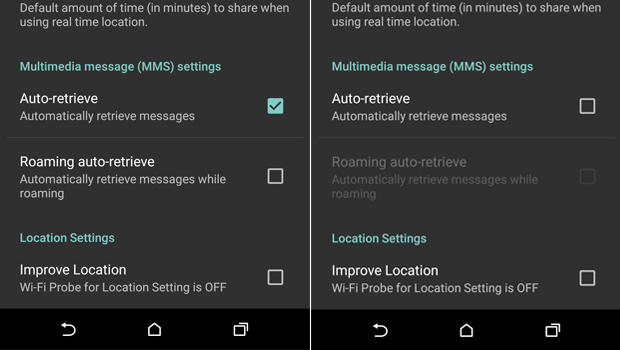
   Meanwhile, there is a work-around.  You need to configure your messaging app to not automatically download MMS messages.

  1. Open you rmessaging app.
  2. Go to Settings
  3. Select: Multimedia messages
  4. un-select Auto Retrieve
   Now, when someone tries to send you a message with multi-media content, you'll see that the message arrived, but the photo or video will not be downloaded.  Only tap to download if the message came from a trusted source.

   Of course, you should also keep your phone patched by applying all phone and app updates.  And... get rid of any apps you don't need.

   Here are some references for more info.

Tuesday, August 5, 2014

When Androids Attack!

   All computers, devices and software have flaws.  In fact, there are so many it's hard to keep up.  In the past (not so long ago), we only had to worry about computers... and they were mostly big desktops.  Then came laptops, and with them the additional problems introduced when connecting to unknown and open networks.  And lately, we seem to spend plenty of time talking about flaws in smartphones and tablets.

   The latest in a long string of smartphone issues is the so-called "Fake ID" flaw affecting Android devices.  This attack exploits a vulnerability in the way an Android device checks the authenticity of an app.

   The issue is kind of similar to controls around US credit cards.  When you sign a credit card receipt or at a terminal, the clerk or cashier might check that signature against the one on the card.  Even if the signatures match (and when does that happen???  I can barely duplicate my own signature! :-), that doesn't mean that you are the owner of the card nor does it let anyone know if the card is fake or stolen.

   In a somewhat analogous way, apps are "signed".  The flaw allows Android phones to accept unverified apps.  This provides a potential opportunity to download fake or malicious apps.

   This issue should be patched on your phone by now.  But this is not the first time this kind of problem has emerged. And it won't be the last time!  This can be a serious issue.

Tuesday, July 22, 2014

Beach to Breach - It's not just for work data!

   I heard a great term recently... Beach to Breach.  SC Magazine did an article about a Sourcfire study on employees bringing their portable devices on vacation.  They found that 77% of employees bring their devices with them on vacation to keep in touch with work and that 97% of the use is email.

   Hopefully you can see some of the security problems right away... the devices have a good chance of getting lost or stolen when one is out of their "element"; plenty of opportunities to connect to unknown networks; potential to use hotel printers; possible "incentive" to bypass controls to see that one "important" message, and of course; sand in our devices!

   Organizations certainly should be concerned about the potential for breach of data or loss of equipment.  But what about the rest of us?  Should we take extra precautions with our personal devices and information when out of town?... Definitely!

Tuesday, December 25, 2012

A Few of My Favorite Things - Apps

   I recently (finally) got modern smartphone.  My previous phone was the "free" phone from over 2 years ago.  Even when I had a basic smartphone I very quickly found useful apps that used everyday.

   Someone was recently asking me what apps I use on my phone.  I thought it would be useful to make a list of some of my favorites here and focus on those that I use most.